
Legal Virtual Assistant for Law Firms
A legal virtual assistant is a remote professional who provides legal support and administrative work to a law firm, a solo practice, or other legal professionals, under attorney supervision. Virtual legal assistants and legal assistants in this sense are not a substitute for a licensed attorney, and they are not a source of legal advice. Legal work that requires a license stays with the lawyer.
This article explains what a legal VA can take on, based on the tasks Masterly Virtual Assistants lists on its live executive and legal assistance page. It is written for small law firms, solo attorneys, and other legal professionals. Related audience pages include small law firms, solo attorneys, and legal professionals. It does not invent pricing. Confirm the cost structure, whether a placement fee applies, and any hourly rates or published rates with the team. No costs or hours packages are listed here. This is not a Masterly Legal Solutions article, and it is not legal advice. To discuss a match, call (888) 209-4055 or contact us.

What a Legal Virtual Assistant, Virtual Legal Assistants, and Legal Assistants Can Do for a Law Firm
Many lawyers hire a virtual assistant so they can protect attorney time for client meetings, court, and case strategy. The assistant takes legal workflows that are administrative: files, deadlines, intake, and communication. The supervising attorney remains responsible for the legal services the firm delivers.
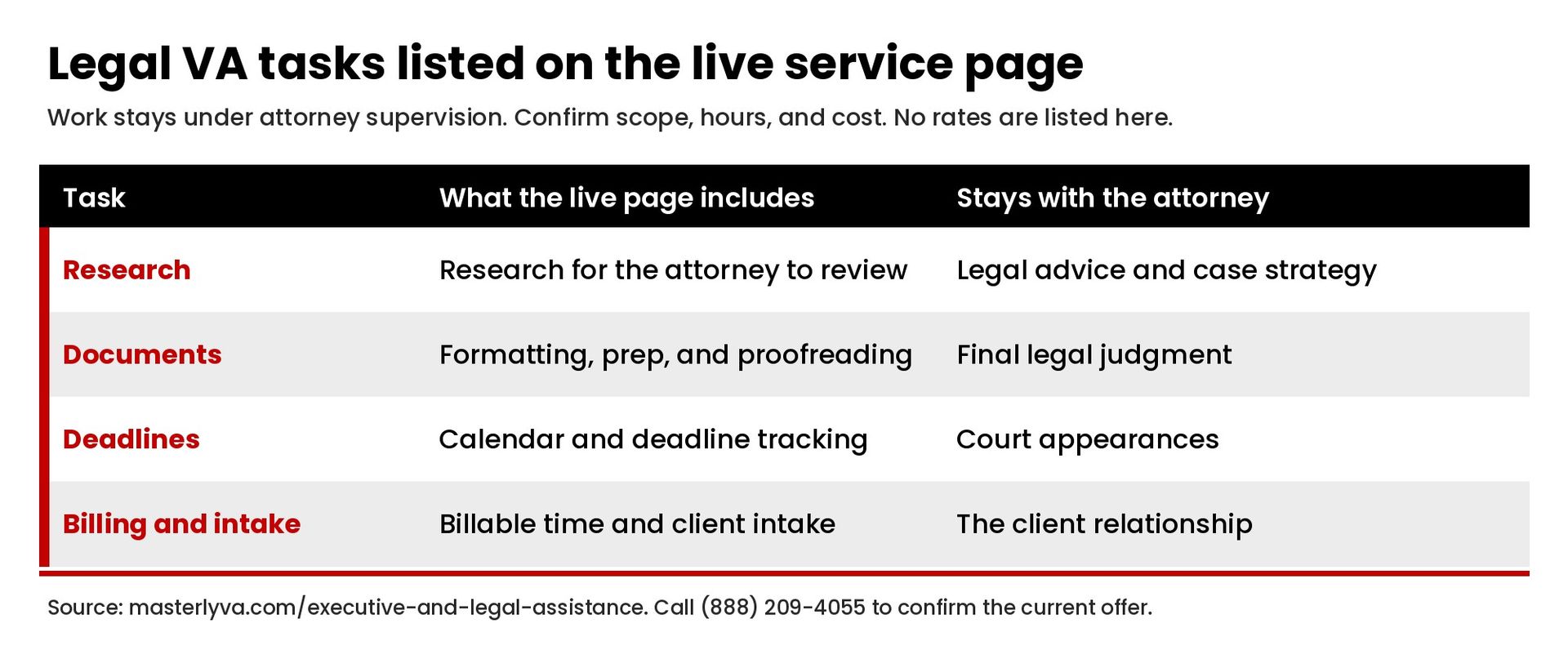
On the live executive and legal assistance page, legal support includes:
- Legal research to inform cases and prepare for client meetings, always for the attorney to review.
- Drafting and formatting professional legal documents, letters, and contracts, and document preparation for legal filings, under attorney supervision.
- Proofreading legal correspondence and document review for accuracy and clarity, not as a legal opinion.
- Billing support, including tracking billable time and maintaining case management systems.
- Handling client intake and onboarding of new clients.
- Coordinating client communication with clear updates.
- Calendar management, deadline management, and deadline tracking.
- Document organization, version control, and file management.
- Related administrative work such as reports, presentations, and scheduling.
The right person for a firm depends on the practice area and the tools the office already uses. Confirm the scope in writing.
Legal Experience, Legal Services, and Legal Workflows: What Stays With the Attorney
Legal experience helps an assistant follow the firm's process, but it does not turn the assistant into a lawyer. Case strategy, legal advice, appearances, and the final review of work product stay with the attorney. Paralegals, where a firm uses them, have their own role and rules. A virtual assistant should not be asked to fill a licensed role by another name.
Practice area fit should be confirmed. Teams sometimes ask about criminal law, corporate law, immigration, or litigation. Those examples are questions to raise on a discovery call, not a claim that every practice is already covered. If the live pages do not list a practice, do not assume it is in the service.
Client information requires care. Confidentiality is part of the live page's description of the work. Use least privilege permissions so the assistant has access only to the files and tools needed for the assigned tasks. The firm still sets the access policy.
Ongoing Support, Discovery Call, and Hiring for Small Law Firms and Solo Attorneys
Ongoing support works when working hours, communication, and review cycles are defined. Billing, scheduling, and deadline tracking are easier when the assistant and the attorneys share one calendar and one set of tools.
Hiring often starts with a discovery call: the firm describes the tasks, the tools, and the supervising attorney's process. Ask about training, how you will assess candidates, whether a practical test is used, and how rigorous screening is handled. The service pages describe vetting and matching; confirm the current process rather than assuming a particular method.
Some teams ask about staffing from Latin America or other regions. Confirm the actual staffing model with the provider. This article does not describe, and does not rely on, a Latin America program.
Benefits of this support are practical for a legal business: more attorney time for legal work, better document organization, and more consistent client communication, which can support client satisfaction. Those benefits depend on the match and the firm's process. They are not guaranteed.
Cost Structure, Placement Fee, Hourly Rates, and Published Rates
Cost structure varies by hours, scope, and whether a placement fee is part of the arrangement. Hourly rates and published rates, if any, should be confirmed with the team. This article does not list costs, hours, or fees. Ask during the discovery call, and get the terms in writing before you hire.
A virtual administrative assistant article covers general admin work. Legal support is narrower and should stay under attorney supervision.
A Short Brief for the First Weeks
Give the assistant a written process: how files are named, how deadline tracking is done, who reviews outgoing documents, and how billing support is checked. Start with calendar management, document organization, and intake for a small set of matters. The supervising attorney should review work until the standard is clear.
Professionals on both sides should know who the point person is. If the firm grows, the same process can extend to more files. If something is unclear, tighten the process before you add volume. Administrative support only helps when the firm's own system is understandable.
Frequently Asked Questions
Is a legal virtual assistant the same as a paralegal?
Not automatically. Confirm the title, the tasks, and the supervising attorney's process. Licensed legal work stays with the attorney.
Can the assistant handle billing support?
The live page includes tracking billable time and case management systems. Confirm the tools and the review process.
Will you publish hourly rates here?
No. Confirm the cost structure, any placement fee, and any hourly rates or published rates with Masterly Virtual Assistants at (888) 209-4055 or through contact us.
Access, Tools, and a Practical Test
Before the assistant starts, decide which tools they will use and what access they will have. Least privilege permissions should be the default: the person sees the files and systems needed for the assigned tasks, and nothing extra. The firm should be able to revoke access quickly if the engagement ends.
A practical test, such as organizing a sample file or preparing a redacted template under attorney supervision, can show whether the assistant follows instructions. Use a file that does not expose real client information.
The office still belongs to the lawyers. The assistant is support for the team, not an independent legal practice. Keep that line visible in the way work is assigned and reviewed.
Keep Legal Judgment With the Attorney
A legal virtual assistant can take legal support and administrative work off a busy firm: legal research for the attorney's review, document preparation, deadline tracking, billing support, intake, and client communication. The lawyer keeps case strategy and legal judgment. Confirm tasks, access, hours, and cost before you hire. No rates are published in this article.
To get matched, contact Masterly Virtual Assistants or call (888) 209-4055, or start with executive and legal assistance.